This Photograph, This Viewer: The Solitary Encounter with Images
Every photograph is born of circumstance — a fragment torn from the unruly current of time — and thus resists any stable or universal meaning. To signify, it must disguise itself, must wear a mask that gestures toward generality even as it hides the irreducible specificity of its moment. Yet most photographs, beneath my gaze, remain inert. They exist, but they do not live. Even those that manage to hold me for a breath rarely cross the threshold of mere attention. They do not pierce. They do not wound. They are without punctum. What remains is studium: a field of polite curiosity, a choreography of cultural consent. It belongs not to love, but to liking — a half-lit chamber where interest drifts, nodding with approval, yet untouched at its core.
To perceive the studium is to trace the photographer’s intention — the echo of their choices, their symbols, their myths. It is comprehension without communion. For studium emerges from culture itself: a quiet contract between maker and viewer, an unspoken diplomacy that permits understanding without intimacy. It is an education of the eye, a courteous exchange of recognitions. The photograph, in this register, becomes not revelation but discourse — a conversation conducted at arm’s length, where beauty behaves and meaning stays within the lines.
Yet every photograph also carries its own small mythology, crafted to tame its dangerous immediacy. For the photograph, left to its own devices, threatens us: with its stillness, its silence, its proof. Its unblinking “this has been” exposes too much — the irreversibility of time and the nearness of loss. And so we burden it with intention: to inform, to represent, to surprise, to seduce. We clothe it in significance so that its raw astonishment does not undo us. In response, the studium rises like a calm surface — a mediation between meaning and mystery, where neither dares to touch.
Roland Barthes once described a photograph of the Emperor’s young brother — not remarkable in history, yet unforgettable in its gaze. What captivated him was not the costume, nor the era, nor the figure’s public weight, but the eyes of someone who once knew himself to be alive. In that instant, Barthes felt joy, not through culture, but through encounter. This was punctum: the private wound, the sudden spark, the detail that cannot be translated or shared. Where studium binds us to collective codes, punctum isolates. It is the moment when a photograph ceases to be “a photograph” and becomes this photograph, for this viewer alone.
For Barthes, such moments reveal photography’s tautology — its refusal to say anything beyond its sole, devastating claim: this has been. Unlike painting, which may invent, photography remains faithful to existence. The image and its referent cannot be parted, and the photograph whispers its insistence: Look — this was. In that insistence lies its truest power. Studium is universal; punctum is individual.
Every photograph is a small resurrection that confirms, simultaneously, a death. It shows us what was, and by showing it, reminds us what is no longer. In this way, photography is the most fragile form of immortality — not life preserved, but loss suspended. The shutter does not save time; it exposes its violence. Each image is a wound in chronology, a visible scar of vanishing. This is why the punctum hurts: it reveals that the photograph is not a memory at all, but a relic. A testimony. A trace of being left behind by time’s indifference. We fear the photograph not because it lies, but because it tells the truth too plainly.
As a photographer, I live within this tension — between the civility of studium and the wound of punctum. I do not seek beauty that merely behaves. I wait, instead, for the moment when the image refuses obedience — when something unscripted breaks through the frame and looks back at me. My aim is not to be liked, but to collide: to make photographs that are not simply understood, but felt. If the image does not tremble with its own being — if it does not bear the pulse of “this has been” — then it remains only picture, never presence.
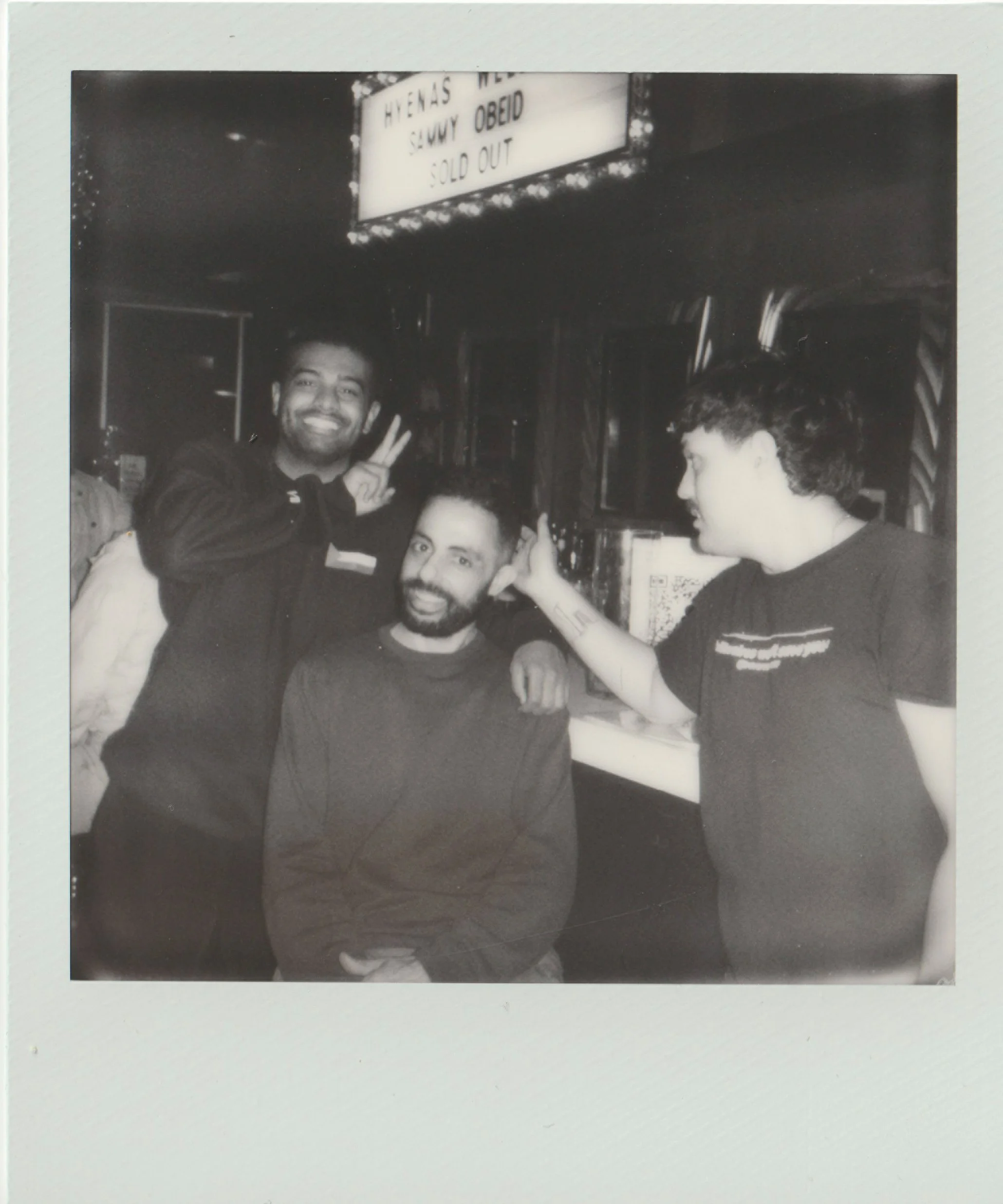
Ahmed Al-Kadri (left), Sammy Obeid (center), and Trevor Carreon (right), comedians, photographed during their U.S. and international comedy tour. Dallas, December 2025. © Noah Winston
The photograph I chose was taken at the Hyena comedy club. A group of men gathers around the bar, smiling at the camera and pulling playful faces. The announcement sign, alcohol, and crowd arrangement clearly signal that an event is taking place. At first glance, the image tells a simple, easily readable story: friends enjoying a night out. This is where the studium lives—within the cultural markers of social gathering, celebration, and shared experience. Anyone viewing the photograph can understand the setting and recognize the effort to capture a lighthearted moment.
What transforms the image for me, however, is the punctum. Sammy Obeid stands apart from the playful chaos, smiling directly into the camera, undistracted by the antics around him. His posture feels intentional, almost invitational—quietly saying “welcome.” This small detail pierces me because it captures who he is beyond the setting: someone gentle, attentive, and deeply committed to human rights, a voice for those often unheard. While others perform for the camera, he simply is.
The tension between studium and punctum reveals how photographs operate on both social and personal levels. The studium provides a shared understanding of the moment, while the punctum disrupts that familiarity, creating a private emotional connection. Without studium, the punctum would lack context; without punctum, the image would dissolve into forgettable friendliness. Together, they create meaning that is both accessible and deeply personal.
This photograph exemplifies Barthes’ theory by showing how an ordinary social moment can carry profound personal resonance. It reminds me that photographs are not just records of what happened—they are emotional triggers, capable of holding cultural significance while quietly piercing the viewer in ways that words often cannot.
